*This is a two-part entry. Because we are who we are, the first is a narrative account by Laura, and the second is informational, and by Max.
One of my favorite things to see while traveling is a couple of gringos in a bad mood. In Santa Marta, while trying to mail a letter, I saw two gringo backpackers in a particularly bad mood. In the post-apocalyptic
Mad Max sun of Colombia during August, these two were heavily laden with packs and hurricane relief amounts of water. The quantity of stuffed compartments and pockets in their packs suggested that even their backpacks brought backpacks. They had just stepped out of a cab and were standing in the middle of the street slowly turning this way and that, mouths agape, hair sweat plastered to flushed cheeks. I laughed aloud at them, really taking pleasure in their sour expressions. I pointed them out to the salesclerk and we laughed together. I wasn't really laughing at them as much as at the idea. This is the reality of that romantic moment when one turned to the other, deeply in love, and said
Let's quit our jobs and backpack through South America. I found pleasure in the fact that this couple's dreams of hostel hopping and salsa dancing turned into a grueling experience in schlepping. I also appreciate the irony that I am often that same type of gringo, dreams of an iced Americano barely disguised behind my own flushed and sweaty face. Max and I are out here for a year, and sailing is constant work, so I often excuse myself for my moodiness and "first world" daydreams. However, our recent experience on the Pacific coast of Colombia really pushed the limits of my endurance.
We arrived in Bahia Solano, a small village 70 miles down Colombia's Pacific Coast, and dropped anchor in a dark bay at 4:30 a.m. Navigating in took much longer than expected, and due to our lack of specific information about this area, felt deeply mysterious. It was dark, we were flanked by jungle shores on either side, and a fine rain persisted. It was the type of rain that seemed to whisper of its own endurance. Max and I went on watch at 11:30 pm thinking we would be arriving shortly. The bay was intimidating, visibility poor and we motored slowly. At 4:30 a.m. we felt we were close enough to think about anchoring. There is a considerable tidal range on the Pacific coast, 12ft more or less, and we couldn't see the shore. We watched the depth finder go from the hundreds down and up and down until we saw 20 feet and a strange line in the water not too far off. We couldn't make out this line but sensed we didn't want to get closer. We dropped our new Rocnar anchor and it held. At 5:00 a.m. we went to sleep.


A few hours later we woke up. I was immediately in a bad mood. I didn't even want to go above deck to see what I was sure was going to be a bleak, hot, rainy coast. Max's far too awake and smiling face only intensified my feelings. Why couldn't he feel annoyed too? Or even a little tired? Why do I always have to be the one in a bitchy mood? When I went above deck the little town only looked slightly less mysterious than it had in the dark. We were the only sailboat anchored in a vast bay. The strange line in the water was clearly the shore of a quarter mile long mud shoal revealed by low tide. Across this muddy expanse, where tall white egrets stood frozen hunting and town dogs were running full out after gulls, was a sort of town. A splattering of buildings, some facing the water, others not, some active, others cement shells.To the right of town, at the end of a mud road was a loading dock where men were emptying the contents of a rusty barge into smaller trucks. A few buildings teetered on stilts with long cement staircases that disappeared into the water. One was a military post, one seemed to be a bar for the fishermen whose long, narrow boats were anchored close by. Boys in underwear were jumping into the muddy water, camouflaged army men were busy as ants, and three wheeled cabs labored along the muddy road back and forth from town. Everything else, as far as we could see, as high as we could see, and in the visible distance was dark, impenetrable jungle. The atmosphere was a thick mist of rain that seemed to begin at the tip of my nose. "This place is spooky," Max's sister said, and I couldn't help but agree. Snipets of things I had read and heard about this coast floated through my thoughts.
The FARC are active there. There aren't any roads out because of the rain. Buenaventura, a large city to the south, is were all the coke leaves Colombia. Don't go there. Don't go anywhere on that coast. There is nothing but FARC, cocaine, and jungle. That was what was told to us again and again. But what could we do? We had to stop after the Panama Canal, and before the Galapagos. We needed supplies and to swap out crew. We needed fresh water and a fumigation certificate to get into the Galapagos. I looked into the distance trying to discern what would be possible here and my heart sank. Just then Max popped his head up through the companionway with a huge smile and declared, "This is the perfect place to clean the bottom of the boat!" I looked at the opaque water, the mud flats dotted with trash, thought of the algae growth on the bottom of the hull, and looked back at his beaming face. If I had a whack-a-mole mallet, I would've whacked him right back into the boat.
Sleepy and grumpy, I piled into the dingy with a much more jubilant crew. It was a wet, wet world and we set off to explore Bahia Solano, beginning with the loading docks. We ended up in one of the three-wheeled transportation devices for lack of a more accurate term, and made our rickety way into town. That was pretty cool. I sat in the front with the driver and my only comment was, "Hay mucha lluvia aqui, no?"
"Si," he replied, "Todos las dias." Oh good I thought. That should make things fun.
Our little taxi delivered us to a plain, one story brown house with a front door and two windows. "Immigration," our cabby said, "Ocho mil." I gasped at the cost of the cab ride. That was almost 2 American dollars. Were we getting a gringo price? We knocked on the front door and a woman in her pajamas answered. We inquired and she shut the door. When it opened again, a man in uniform welcomed us into a front room. On a white tiled floor, ten black plastic chairs were in a row next to a giant Colombian flag hanging from a pole. There were a few desks, posters on the wall that offered tobacco free air next to images of x'd out hand guns. Max communicated the ever stranger saga of how we four came to be there to the man who entered things into some abyss of computer program. The poster calendar on the wall read 2013.


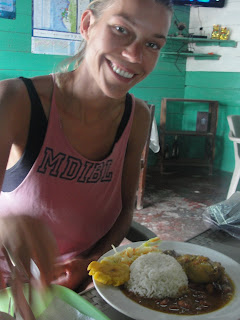
Once released, we decided to escape the rain by ducking into a restaurant for an almuerzo. In Colombia, almuerzo begins with a thick soup long-simmered with bones and root vegetables, and then, once you are full and your body temp is up, a plate of beans, rice, salad and meat is served. A cup of ice cold, extremely sweet sugar cane juice with lemon arrives. At the end you are Thanksgiving full and a few bucks poorer. Max and I love almuerzo. We love to pretend each is different and rave about it.
I got a piece of meat in my soup! This tea, or whatever, is amazing! Why did I ever think I didn't want to eat thick, hot soup at noon when it was 100 degrees? At the end, Max loves most asking what the bill will be and then calculating the USD equivalent.
That's only 8 bucks! Price is the best spice, I remind him.

After almuerzo, which was excellent for morale, we split up and Max and I went in search of kerosene. Bahia Solano is small. Just a handful of muddy streets. Too few to name, I think. There are many small restaurants and stores selling housewares such as plastic bowls, plastic containers, pots of all sizes, camping stoves that run on gasoline, and clothing wrapped individually in plastic. All stores and shops are open to the street with awnings for the rain. Everyone we asked about kerosene had an answer- either it was definitely available or definitely not available. Whenever it was suggested to us that it was not available, Max told people that it surely had to be because kerosene is the same thing as jet fuel and there was an airport nearby. This information really confuses people. They begin by simply processing the facts, and then they have to wonder how one obtains jet fuel. I like to imagine us walking down the local tarmac in our tattered clothing, 5 gallon fuel containers in hand, and knocking on the side of a jet to ask if we could just siphon off a bit before take off. We would explain to them how our cute little stove works, tell them the adorable story of our sailing life, and seeing the good in us, they would surely delay the 1pm to Medellin to help us out.
Where we ended up I could not have imagined. At the end of the main drag in Bahia Solano is a sort of fuel shack by the shores of a trash strewn river populated by turkey vultures, egrets, and half naked little boys. A fuel shack is like a gas station except that all the fuel is kept in make-shift containers, and the serviceman, though high as a kite, knows everything about the different fuels offered. We had a great time there. He demonstrated each fuel in turn by pumping, pouring, or ladling it into an iced tea pitcher. We analyzed color and clarity, and when he suggested we take a sniff, we swirled the pitcher and inhaled deeply. We put our fingertips in and rubbing them together discussed dryness and viscosity. In the end we were even more confused. What was kerosene anyway? How was it different than diesel? I had all these new questions, and we had no kerosene. As we walked away, Max told the man not to worry. We would find kerosene because it is the same as jet fuel and there was an airport nearby.
Our next hint about kerosene was from the Port Captain who told us that a woman named Maria sells kerosene out of her living room window which is next to the supermarket. This I couldn't believe. After a full investigation of the town, after all the talk of men and planes and gasoline powered cooking stoves. That in the end, Maria had it all in her living room. We found Maria inside a square pink window with white shutters. She came out from behind a curtain and we asked about the kerosene. She nodded towards a milk crate filled with topless glass bottles. We explained our situation and she gave us two water bottles full to try out. Maria found us as amusing as we found her and we all giggled through the transaction. Maybe it was the fumes. When the fuel worked, Max returned to Maria with a 5 gallon container. She had never been asked for that much before and decided she would enlist the help of a siphon. And so, seventy year old Maria, in her living room full of crucifixes, wearing her thin pink pajamas with lace trim, sucked on a hose, and was surprised by a mouthful of kerosene that she spat out on the living room floor. Max cringed at the sight, being all too familiar with the experience. A week later, when we were on our way out of town, we returned to Maria to buy ice. She informed us that we had over paid for the kerosene and gave us 10,000 pesos.
After Maria, we met back up with Anna and Pauli, and to escape the down pouring rain, we slipped into a pool hall. There are pool halls everywhere in Bahia Solano. You can rent a table for an hour and the cost of a beer also works out to around 1 USD. In this pool hall the walls were covered with posters of naked women doing odd things and one picture of Pope Benedict, hung slightly higher. In one poster a woman with a very exaggerated body seems to be lost in the jungle. She could find her way out if only she could locate her Stihl weed whacker which is hiding in a bush behind her. Another woman, an oily blonde, has an anaconda wrapped around her. Its tail is curling up her butt crack and she is holding its head close to her mouth like a, well, microphone. In another bleached out poster, Pamela Anderson is clinging to an iron gate that floats mid-air with her feet up wearing only boots. I tuned to Pauli, "Look at the pope smirking. It's as if he approves of all this." And indeed, he was smiling, hung above the shelf that displayed what was for sale: light and dark rum, and a can of Club Colombia hung with rosary beads. We passed many hours there, drinking beer and playing pool in celebration of Anna's birthday. The locals bought us rounds and were smitten by our foul weather gear, asking where they could get some to deal with the local weather.


The day I decided I loved Bahia Solano I was walking back from town with two bags of groceries. It was really pouring and I was walking through inches of mud. A man on a motorcycle slowed down and offered me a ride. As we sped through the mud I told him I lived in the sailboat and pointed to where Tortuga was anchored. He said, "Everyone knows that," and dropped me off at the loading dock. Max was on the boat with the dingy and I was trying to hail him to get picked up. He didn't see me for a while and I started chatting with a kind old man who ended up offering to take me to Max with his boat. While on the dock he had told me that he lived in Miami for 10 years. In the boat I asked, "What did you do when you lived in Miami?"
"Sold cocaine," he replied succinctly.
"Oh, I said. That's nice. I'm a school teacher."
In Bahia Solano the people are kind and happy amidst the rain and the limited availability of everything. They have a few restaurants, two supermarkets, plenty of Colombian beer, and an excellent fuel shack. The only road in and out gets washed away half the year. There isn't a lot of opportunity, and if you want wifi you have to sit outside the shop were boys work at tables surrounded by disassembled cell phones. They won't accept money, will send the little boy to enter the password into your computer, and will always bring you a chair.
The men at the loading docks drive long and narrow boats with two 200hp 2-stroke outboards on the back. They need these engines because cocaine smugglers throw their goods overboard at the sound of military planes, and the men from Bahia can zoom out to make the recovery. Some make a living this way. They are also happy to move tourists around, go fishing, or give you a free ride. (I timed one of these rides from the dock to our boat. One Mississippi) By the time we left I could no longer judge these people. I come from a community where we discuss our careers in terms of publications, self-fulfillment, and weigh our options of time abroad versus commitment back home. In Bahia Solano, a career is selling kerosene out of your living room or carving whales into wooden paddles. Depending on the time of year, it could also be transporting tourists or fishing enormous Tuna. A whatever works sort of economy.
For us, we could get everything we needed there, whether that means a fumigation certificate for the Galapagos, a hull cleaning certificate, kerosene from Maria, or enough provisions to make it to our next port. After ten days there we had many friends. The boat was wet through and through, mold grew on all surfaces, and the idea of staying dry no longer preoccupied my thinking. When we sailed away from that coast, leaving the rain clouds caught up in the mountain peaks, the boat dried out a little, started to look clean, and it felt incredible. However, something remains in me from Bahia Solano. When I find a wet spot from a leak, or the food I just cooked slides onto the floor, when I fall off the toilet and the toilet seat comes off and hits me, I just don't mind as much. Like the people in Bahia Solano, I just laugh. Life is hilarious, especially when you're wet and miserable. I am sure the grumpy gringo in me will resurface, but for now I am a little dirty and wet, and couldn't be happier.
Captain's Log: Getting Galapagos Entry Documents in Bahia Solano
by Max
We spent a little over a week on Colombia's Pacific coast. An area know for its isolation, eco tourism, and cocain. If you google for information about cruising this area you will be lucky if the name of the town you plan to visit even shows up. Cruisers rarely come here and the best resource we were able to find was a free electronic cruising guide called Pacific Guide to Colombia by Eric Baicy and Sherrell Watson.
Regardless of its reputation, we needed Colombia to be the launching point of our Pacific passagemaking for several reasons. Panama is too expensive and we had no visas or cruising permit that would allow us to stay there for more than 24 hours after our canal transit. Additionally, heading south to Equador or north to Costa Rica would only extend our already ambitious float plan for the next 2.5 months. That being the case, when we arrived in Bahia Solano Laura and I meant business and if there is one thing Colombians understand, it's business. What I love about Colombians is their practicality. No is an unusual word there. They will do thier best to make things happen for you, and they will do so at a fairly inexpensive, previosly discussed price. They are generally fair, friendly, and happy people and you will find yourself getting accustomed to trusting strangers you meet along your way.
We needed goods, services, and documents from the small town of Bahia Solano and they provided us with all three. The trickiest items were the services and docments required by the authorities in the Galapagos for visitng yachts. They require a professional fumigation and hull cleaning of the vessel and the certificates to prove it. I imidiately mentioned the fumigation to the Colombia Coast Guard upon checking in. They assured me such services must only be available in Buenaventura (150 miles to the south) because they had never heard of such a thing on a boat. When I asked who provided extermination services for the local houses, they confessed that the local director of sanitation might be able to help. I mentioned this to our agent, Juan David Tapias Rivera (phone number (57)3124667987 email transbahialtda@yahoo.com.mx) and by the next evening our boat was fumigated. The signed certificate was delivered to our boat a few days later.
The hull cleaning proved to be more difficult, which I hadn't anticipated. Our savior came in the form of a Colombian named Rambo who cruises around in a small boat with an oversized Colombian flag mounted at the bow. Rambo is packed with energy for a man about to turn 60. He does a little bit of everything including breeding dogs, delivering people and goods in his boat, providing rooms for backpackers at his house on a secluded beach, delivering deisel, and apparently hull cleaning. Everyone in town knows him and you get the feeling everyone that knows him owes him a couple of favors. When I told him I needed a professional hull cleaning and the paperwork to prove it, he imediated offered to do it for 60 USD. It took him a few days, given how busy he is, but he eventualy dove the boat using his own diving equipment and gave me a ride to a fiberglass boat building factory to have a fake reciept and description of services writen up. The man writting the reciept was even kind enough to list the cost of services as 250 USD instead of 60 USD to make it seem more legitimate. I was so greatful to be spared a trip to Buenaventura, I paided Rambo and extra 15 USD. Currently we are in the Galapagos and just passed our hull inspection, without which we would've been asked to leave. The diver even came up and said our boat was very clean.
In the end Bahia Solano and its residents were able to provide us with the following documentation at the following costs, which were all required for our arrival in Colombia and trip to the Galapagos.
Fumigation Certificate: 60 USD
Hull Cleaning Reciept: 60 USD
Agent Fee: 45 USD
Check in at Port of Entry in Colombia: 0 USD
Exit Zarpe Lisiting Galapagos as Transient Port: 0 USD